Reactivating former clients: 5 simple campaigns
· 6 min read · Français · עברית

In a small services company, the easiest revenue to go after is almost never with a new prospect. It is with someone who already knows you: a satisfied client nobody has called for a year, a prospect who asked for a quote and then went quiet, a person who replied to your last email and to whom nobody followed up.
These contacts aren't lost. They're dormant. And waking them up costs far less than finding new ones: they know who you are, they have already needed you, and some of them will need you again this year.
Here are five simple follow-up campaigns, to launch one after the other. No mass prospecting, no big volumes: a few dozen well-chosen contacts, and a message suited to each situation.
Before you start: a list, a message, a pace
A good reactivation campaign rests on three things.
- A precise list. The more targeted the list, the more personal the message can be. In a CRM, a list is built with a few conditions and updates itself; it does all the work.
- A short, sincere message. Three to five sentences, a single goal, signed by a person. A follow-up email that looks like a newsletter ends up ignored, or in spam.
- A reasonable pace. Better twenty emails sent well, at the pace of a normal mailbox, than three hundred at once.
In Loukka, each campaign starts from a saved list view. You choose the type (calls, mailing, or both), check the number of contacts concerned, write the message, and the sending is spread at the chosen pace from the salesperson's mailbox. Replies are filed on the right record.
Campaign 1: clients with no contact for six months
Who? Companies that have already bought something from you (at least one won deal) and with whom there has been no exchange for six months.
The list: an account view with two conditions: Won opportunities greater than 0 and Last contact more than 180 days ago (or never).
The channel: a call, if possible. A client who hears their usual contact asking how they are doing doesn't feel chased.
The message: catching up, without selling anything. "How have things been since our last project? What has changed on your side?" Needs often come up by themselves in the conversation.
This is the campaign that brings in the most for the least effort. It is also the one nobody ever does, because nothing signals that a good client is drifting away.
Campaign 2: quotes that went nowhere
Who? Prospects to whom you sent a proposal, and who never said yes or no.
The list: an opportunity view: Status in progress, Stage among Proposal and Last contact more than 30 days ago. A campaign can start directly from an opportunity view: it then targets the contacts of those deals.
The channel: a short email, followed by a call for those who open it or reply.
The message: "I'm getting back to you about our proposal from June. Is it still relevant, or have things changed on your side?" A simple question, which can be answered in one line, gets far more replies than a reminder of the offer's benefits.
Even a "no, we chose another provider" is useful: it lets you close the deal with its loss reason, and so understand where you are losing sales.
Campaign 3: those who read without replying
Who? Contacts who opened your last mailing, or clicked a link, without replying. They showed some interest, at least a little.
The list: a contact view: Campaign (your last mailing), Status in a campaign among Email sent and Email tracking among Opened, Clicked. Open tracking "per contact" must have been enabled before sending, by an administrator, after checking it complies with your obligations (GDPR).

The message: bring something useful rather than chase. A webinar replay, a practical guide, a client case study. "You may not have had time to attend: here is the essentials in thirty minutes."
Campaign 4: those who replied and are still waiting
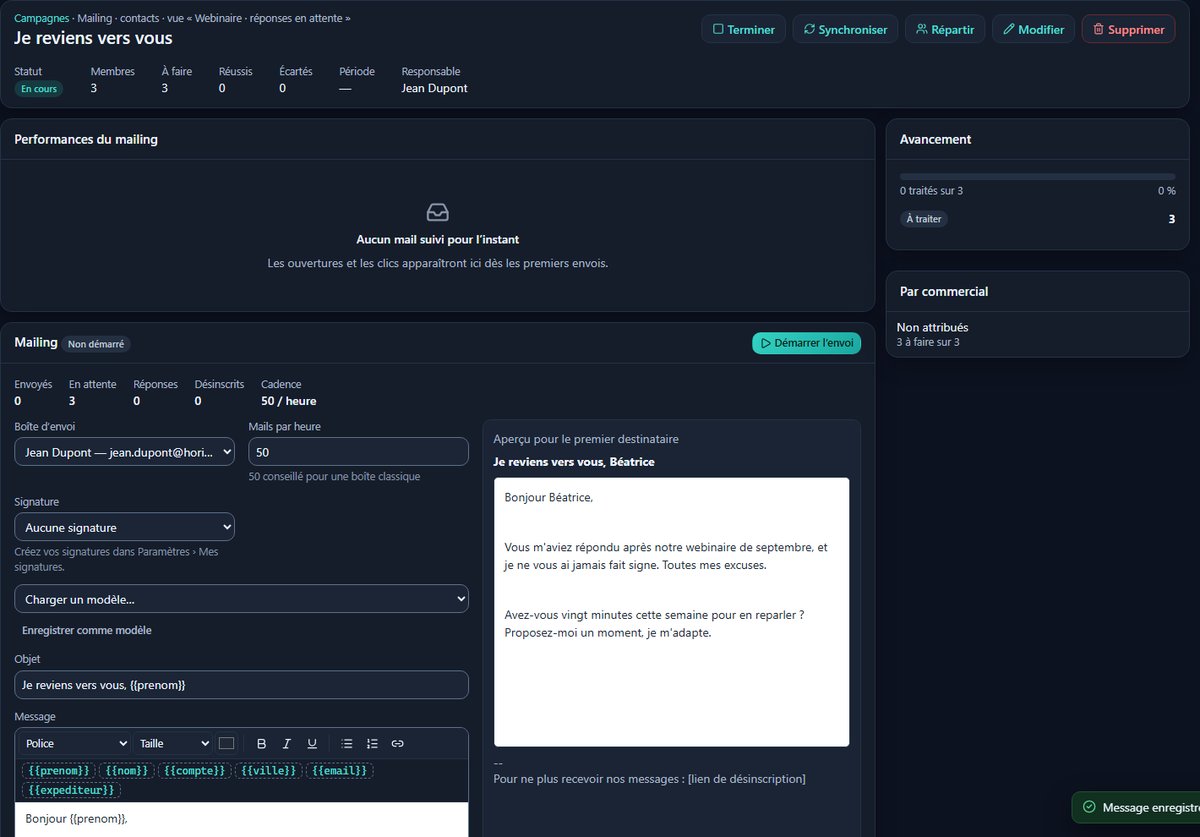
Who? People who replied to one of your campaigns, and to whom nobody followed up. It is the costliest situation: the contact took the first step, and you let them down.
The list: a contact view: Status in a campaign among Replied and Last contact more than 14 days ago. Loukka's daily briefing also flags them every morning in the "Replied, to handle" tile.
You can also simply ask the AI assistant: "Who replied to me after the September webinar and is still waiting to hear from me?" It prepares the list, which you create in one click.

The channel: a personal email, or even a call if the list is short.
The message: acknowledge the silence, without long justifications. "You replied to me after our September webinar, and I never got back to you. My apologies. Do you have twenty minutes this week to talk about it again?"
Campaign 5: deals lost six months to a year ago
Who? Prospects who said no to you six months to a year ago. The reasons for a refusal change: one year's budget isn't the next one's, the provider chosen instead may have disappointed, and the "bad timing" may have passed.
The list: an opportunity view: Status among Lost and Close date between a year ago and six months ago (two conditions: is after and is before). The campaign targets the contacts of those deals.
The channel: an email, very short.
The message: "We spoke last year about your project. Have things moved on your side?" No new offer, no discount: just a door reopened.
Five rules to keep your follow-ups effective
- One campaign at a time per contact. By default, Loukka excludes contacts already in another running campaign: keep that setting, nobody likes receiving three follow-ups in the same week.
- Aim at people, not generic addresses. An email sent to "contact@" or "info@" almost never reaches the right person, and spam filters are wary of it.
- Respect unsubscriptions. Every campaign email contains an unsubscribe link, and an unsubscribed address is never written to again. It's an obligation, and it is also what protects your sender reputation.
- Handle replies the same day. A follow-up that gets a reply and goes unanswered does more damage than no follow-up at all.
- Measure to do it again. Opens, replies, meetings booked: each campaign's results tell you which message and which target to repeat the following quarter.
Frequently asked questions
How many times can you follow up a former client?
Twice, two to three weeks apart, then let a few months go by. Beyond that, the follow-up becomes pressure, and you risk an unsubscription.
Should you call or write?
The two complement each other. Email reaches many people with little effort; a call converts much better. The right method: an email to the whole list, then a call to those who opened it or replied.
Can you follow up former clients without their consent under the GDPR?
In B2B prospecting, you can write to a professional about their business, provided you let them easily object to any further sending, which the unsubscribe link does. For your clients, the existing business relationship justifies contacting them again about your services.
Conclusion: your former contacts are dormant
Reactivating former clients is nothing spectacular. Five lists, five short messages, a few hours a month. But it is often the most profitable source of revenue for a small services company, because it addresses people who already know you.
Your former contacts are dormant. Loukka wakes them up. To see these lists and campaigns on a fictitious team, with its replies and its AI assistant, Loukka's demo is available with no meeting and no commitment.